


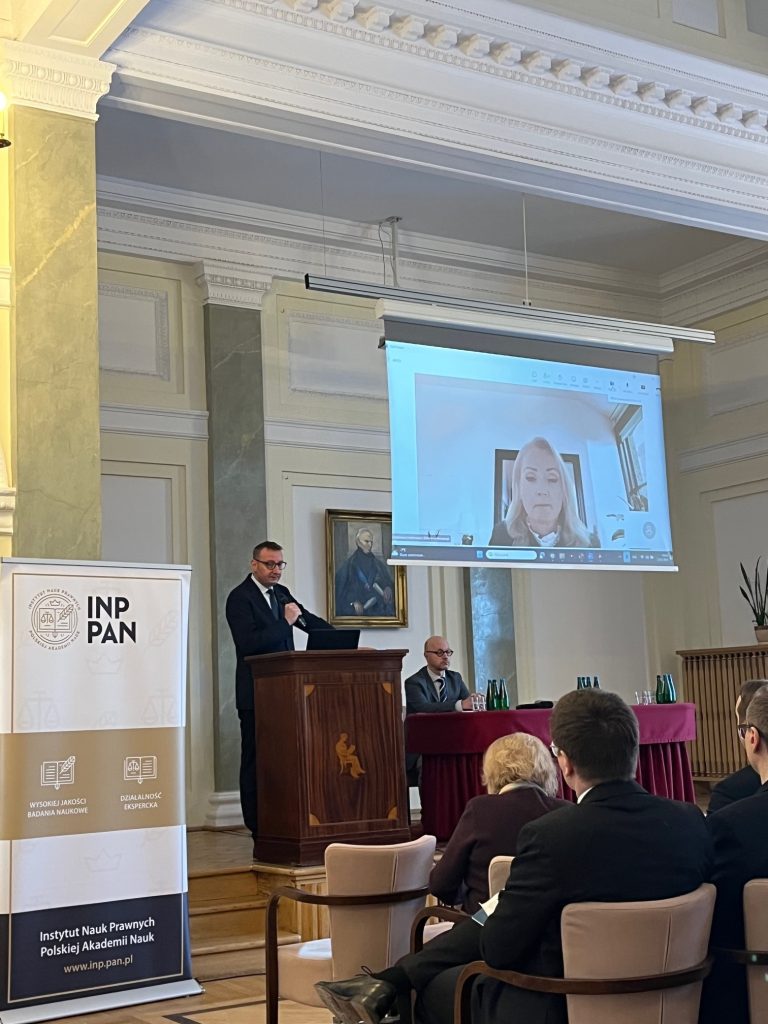
Compulsory bank restructuring, as one of the key instruments for safeguarding the stability of the financial system, was the subject of the first academic seminar organised by the Centre for National and Economic Security Law on 12 January 2026. The event simultaneously inaugurated the Centre’s activities. The seminar was held under the patronage of the academic journal Przegląd Ustawodawstwa Gospodarczego (Economic Legislation Review).
On behalf of the management of the Institute, the seminar was opened by Dr Wojciech Drobny. The first part of the proceedings was devoted to the system and organisational framework of compulsory restructuring (resolution) authorities.
Prof. Małgorzata Fedorowicz recalled that compulsory restructuring authorities, including the Bank Guarantee Fund, form an integral component of the financial safety net in European Union Member States. She emphasised that the fundamental objective of institutions constituting the financial safety net is to ensure financial stability. Consequently, this objective should be taken into account both in the interpretation of legal provisions and in the assessment of decisions to initiate compulsory restructuring. In her view, financial stability should be regarded as an overriding systemic value, justifying a strongly functional approach to the interpretation of the Bank Guarantee Fund Act.
Prof. Paweł Szczęśniak focused on the issue of the accumulation of functions within the Bank Guarantee Fund. He pointed out, inter alia, that both Polish and European Union law permit the combination of the functions of deposit guarantor and resolution authority within a single entity, provided that appropriate internal organisational arrangements are established.
A broader comparative perspective was presented by Dr Jakub Kerlin from the Warsaw School of Economics, who discussed the institutional models of resolution authorities operating in EU Member States. He noted that there is no single model common to all Member States and that the relevant directive leaves this issue to national discretion.
As Dr Kerlin observed, “it is difficult to establish a single typology due to the mosaic of systems, which results in a wealth of internal solutions adapted to local specificities, such as a country’s administrative tradition or approaches to avoiding conflicts of interest.” He further noted that integrating a resolution authority with a central bank or supervisory authority gives rise to heightened expectations regarding the separation of functions. In this context, he cautioned that the European Central Bank’s separation model may not be fully appropriate for national resolution authorities, stressing that “the separation of the ECB’s functions has a treaty-based foundation and is driven by monetary policy considerations.”
Dr Kerlin also highlighted a challenge faced by administrative courts in Poland, namely the fact that when the European Commission approves the granting of state aid in the course of resolution proceedings, it assesses the compliance of the measures applied by the resolution authority with European Union law.
The second part of the seminar, moderated by Prof. Joanna Wyporska-Frankiewicz, was devoted to the procedural standards applicable in compulsory restructuring. The discussion demonstrated that although resolution constitutes an administrative procedure, it is governed by its own distinct logic, stemming from the objectives of the regulation and the extraordinary circumstances under which it is applied.
Prof. Grzegorz Łaszczyca drew attention to the structural distinctiveness of resolution proceedings, noting that they deviate in many respects from the classical model of administrative procedure. At the same time, he emphasised that this does not entail abandonment of fundamental standards, such as the impartiality of the authority. As he stressed, “this very high standard is fully maintained.”
Prof. Lucyna Staniszewska highlighted the importance of institutional cooperation and evidentiary issues in resolution proceedings. She noted that decisions to initiate compulsory restructuring are issued on the basis of financial evidence prepared by entities other than the Bank Guarantee Fund itself. In particular, she emphasised the role of information provided by the Polish Financial Supervision Authority in the form of a formal document assessing the financial condition of the bank concerned. Special significance is also attached to valuation reports prepared by entities independent of both public authorities and the bank and its owners. It is these valuations that largely determine the subsequent course and outcome of the proceedings.
Prof. Mateusz Błachucki, Chair of the Centre, presented his reflections on the system and procedure of compulsory restructuring. He focused on issues of impartiality and potential conflicts of interest arising from the multifunctional character of the resolution authority. He emphasised, inter alia, that “the Bank Guarantee Fund generates the fewest areas of conflict among the possible institutional solutions” and that the functions of deposit guarantor and resolution authority “are not competitive, but complementary and mutually reinforcing.”
In his concluding remarks in this part of the discussion, Prof. Błachucki stated that it is difficult to identify either a theoretical or practical conflict of interest between the resolution function and the function of administrator. With regard to the relationship between the deposit guarantor and the compulsory restructuring authority, he argued that any potential conflict is largely theoretical, limited in scope, and effectively mitigated by procedural solutions.
The final panel, moderated by Prof. Grzegorz Łaszczyca, featured Prof. Małgorzata Jaśkowska, Prof. Joanna Wegner, and Dr Rafał Chybiński, and was devoted to the judicial review of decisions initiating compulsory restructuring. The speakers drew attention to the specific conditions governing judicial administrative oversight of decisions issued by the Bank Guarantee Fund. They emphasised, inter alia, the complexity of the subject matter under review and the limitations inherent in administrative court adjudication.
It was pointed out that an administrative court is not empowered to annul a decision of the Bank Guarantee Fund and remove it from legal circulation. The court may either find the decision lawful and dismiss the complaint, or—if it identifies defects—declare that the decision was issued in violation of the law. However, not every infringement of legal provisions is sufficient to support such a finding. The existence of a violation must be demonstrated, together with its relevance to and impact on the substance of the decision. Only violations that materially affect the content of the decision may justify a finding that it was issued unlawfully.
The seminar was attended by nearly 100 participants, including representatives of academia, public authorities, and administrative courts. Participants agreed that this was the first event to offer such an in-depth and comprehensive analysis of compulsory restructuring procedures. Commenting on the discussion, Prof. Marcin Dyl of the University of Warsaw observed that the initiative was particularly valuable given that compulsory restructuring serves to protect the public interest, combining concern for the stability of the national financial system with the interests of thousands of bank customers.
The seminar was formally closed by Prof. Mateusz Błachucki, who thanked the speakers, participants, and the patron journal for their contributions to the success of the event.